Private healthcare groups
Outpatient software for your facilities, consistent across the whole group.
Patient records, scheduling, billing, indicators and access logs in a single tool. Deployed facility by facility, it sits alongside your inpatient EHR without replacing anything.
Talk to us about your workflows Write to us
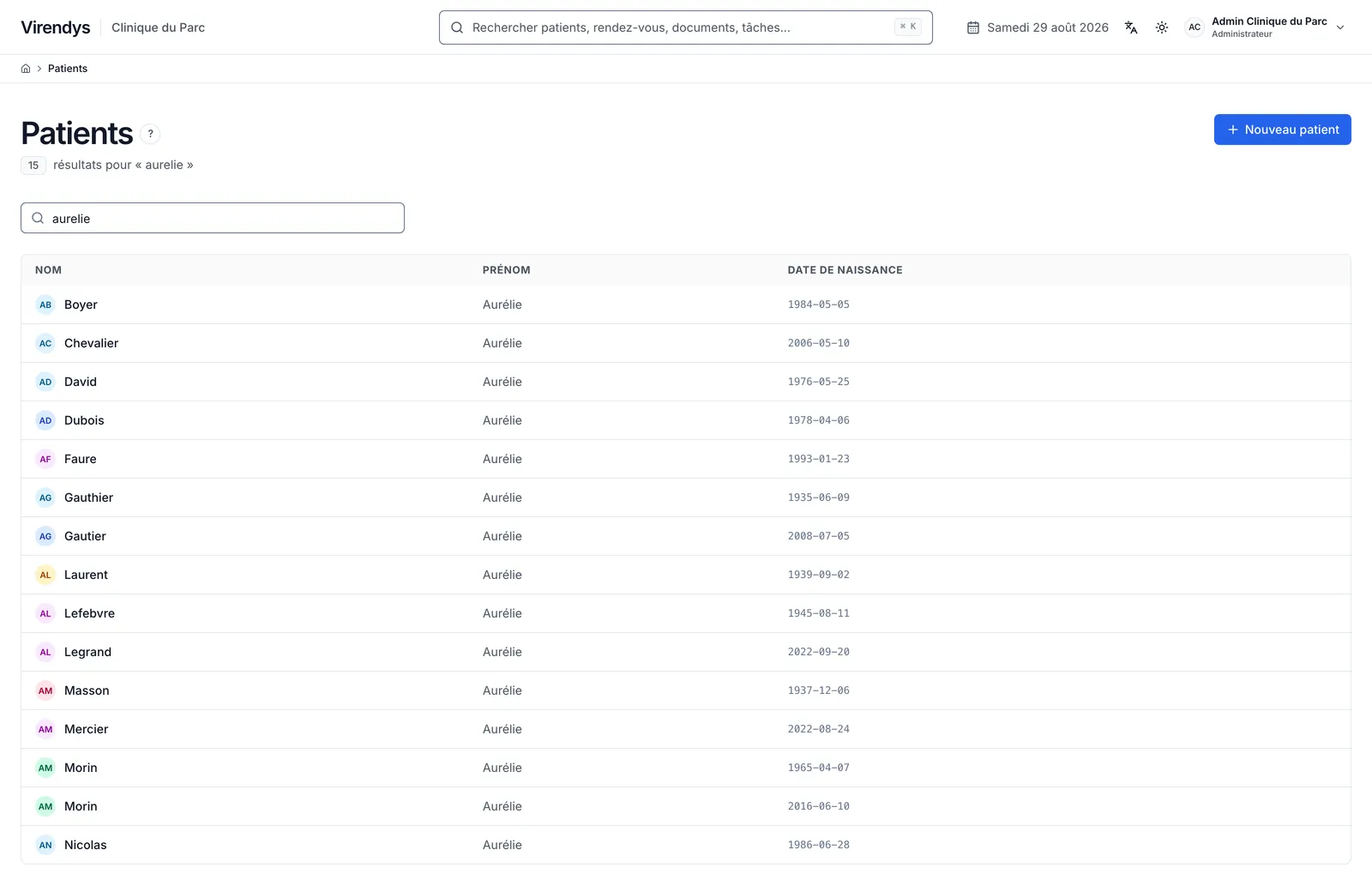
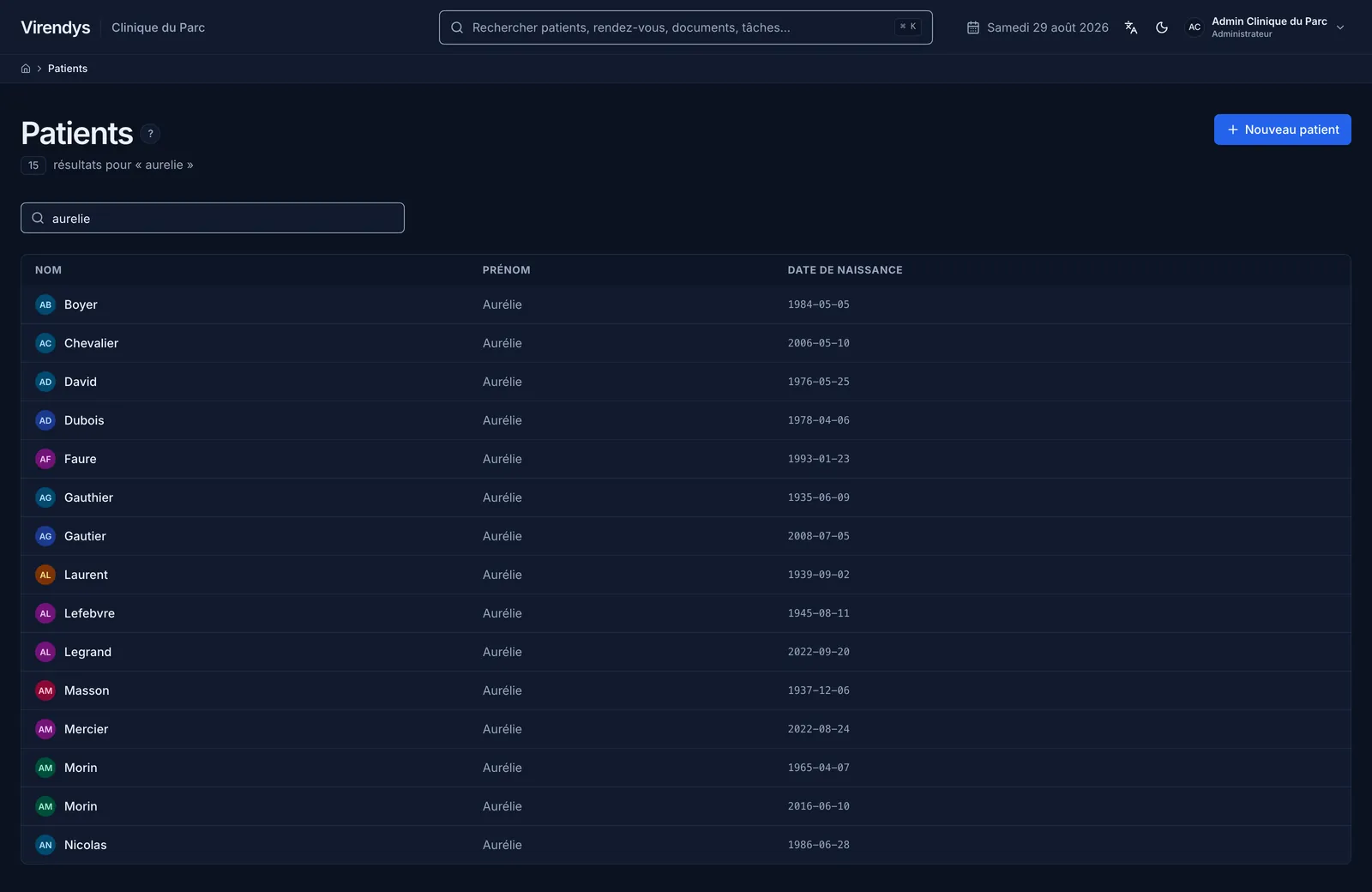
Front desk finds a patient despite the spelling
Search tolerates accents and typos. Typing “aurelie” finds all fifteen Aurélie in the file.
Demonstration environment filled with synthetic data. No real patient data appears here.
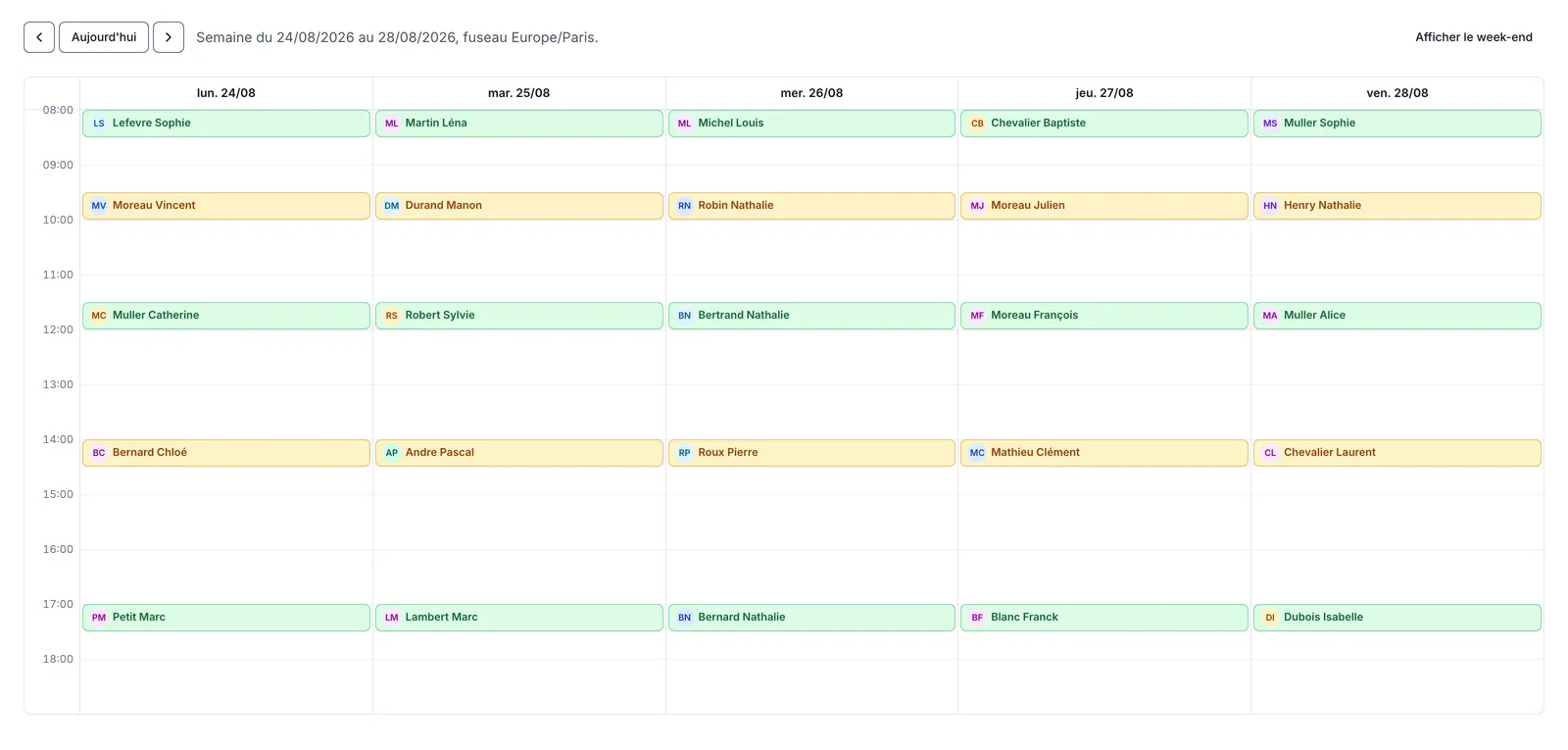
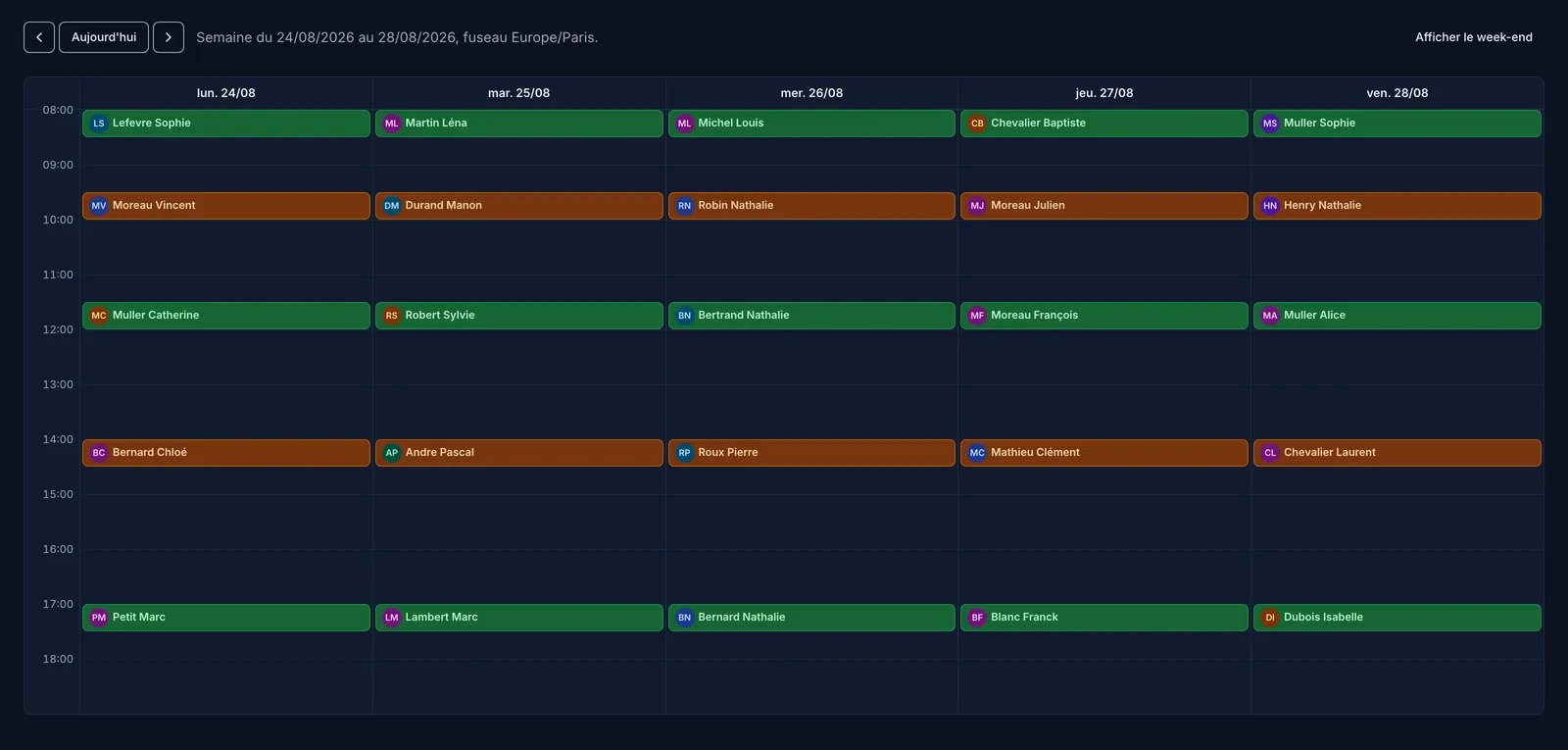
Two appointments cannot overlap
The conflict is refused by the database as the record is written, not flagged afterwards. The classic case — front desk and practitioner booking the same slot in the same second — cannot happen.
Demonstration environment filled with synthetic data. No real patient data appears here.
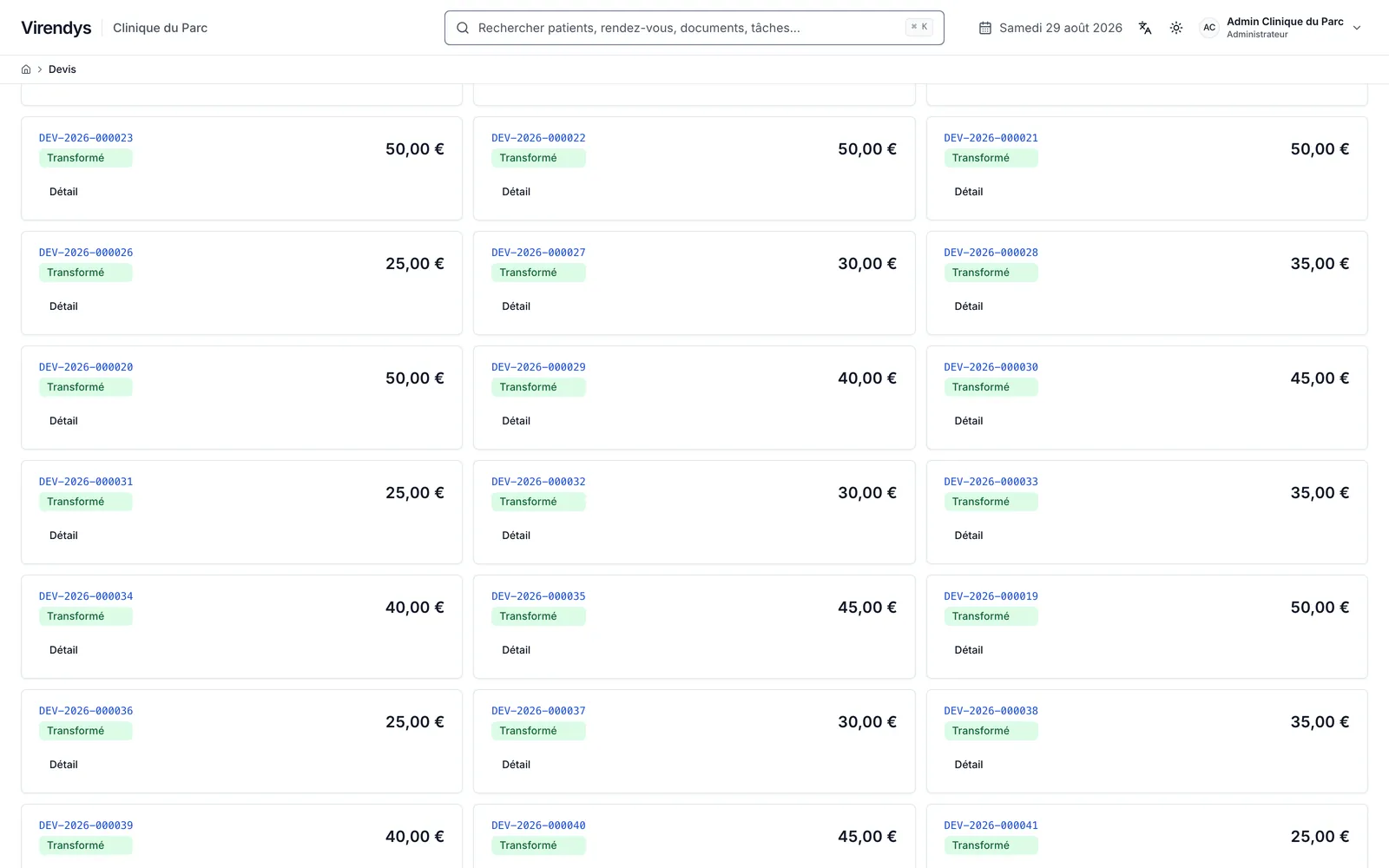
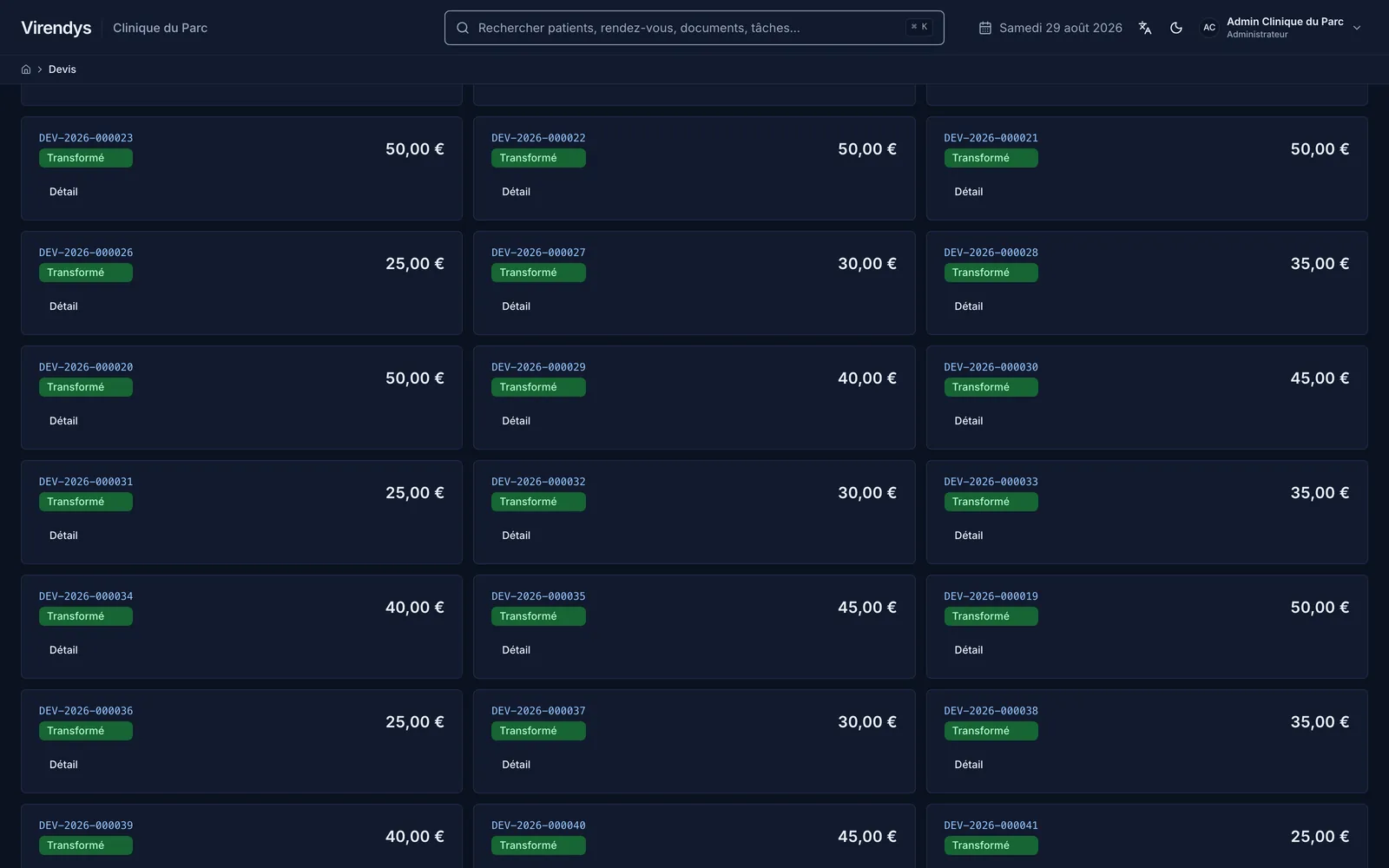
A quote becomes an invoice without re-keying
Quote, invoice, payment, printable PDF. Continuous numbering, with no gaps.
Demonstration environment filled with synthetic data. No real patient data appears here.
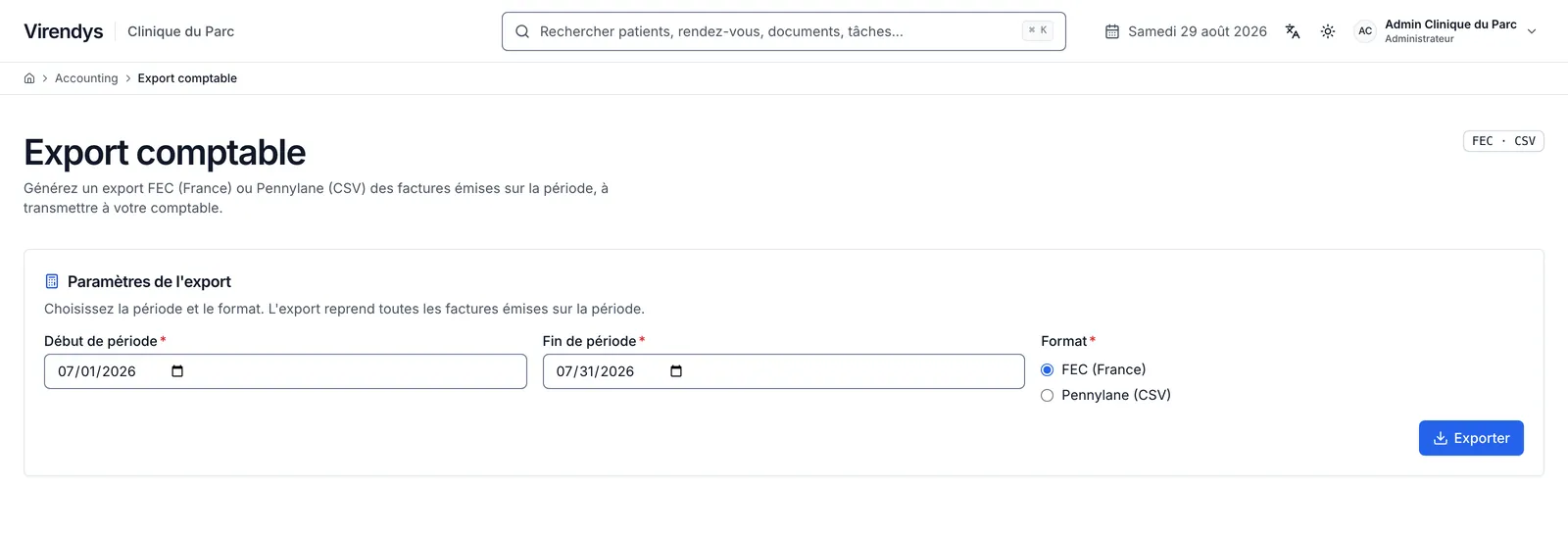
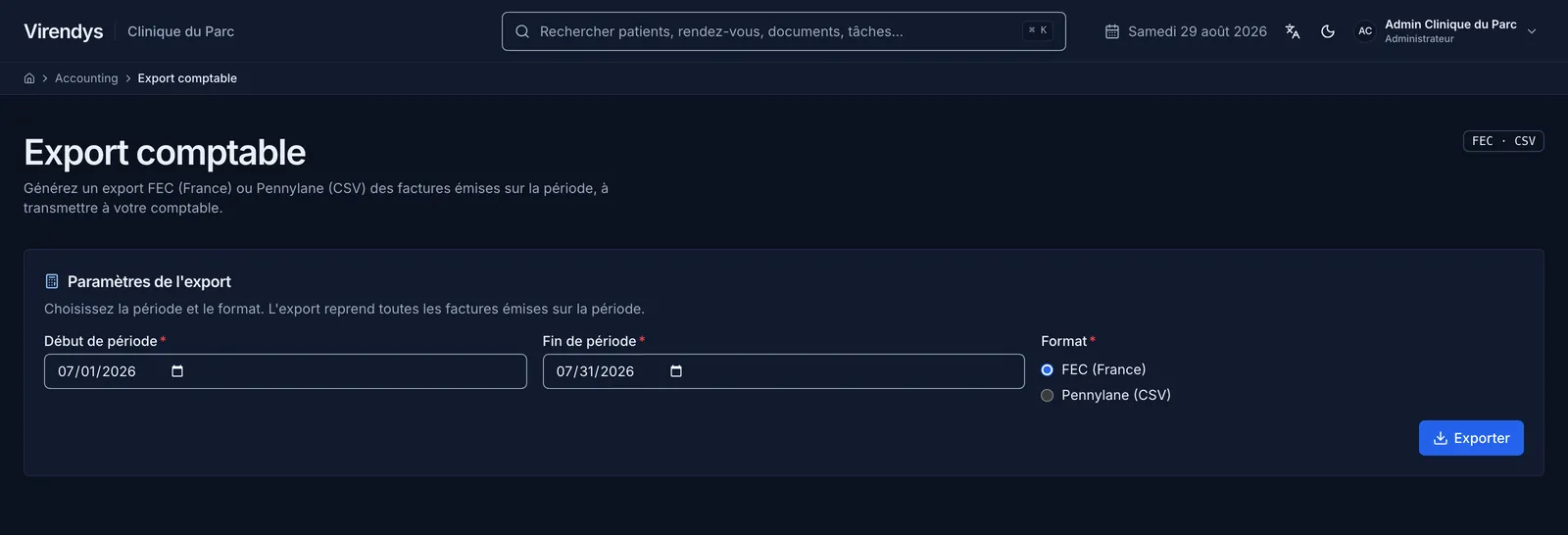
Your accountant receives a file, not a spreadsheet
Export in FEC and Pennylane formats, generated from the invoices actually issued.
Demonstration environment filled with synthetic data. No real patient data appears here.
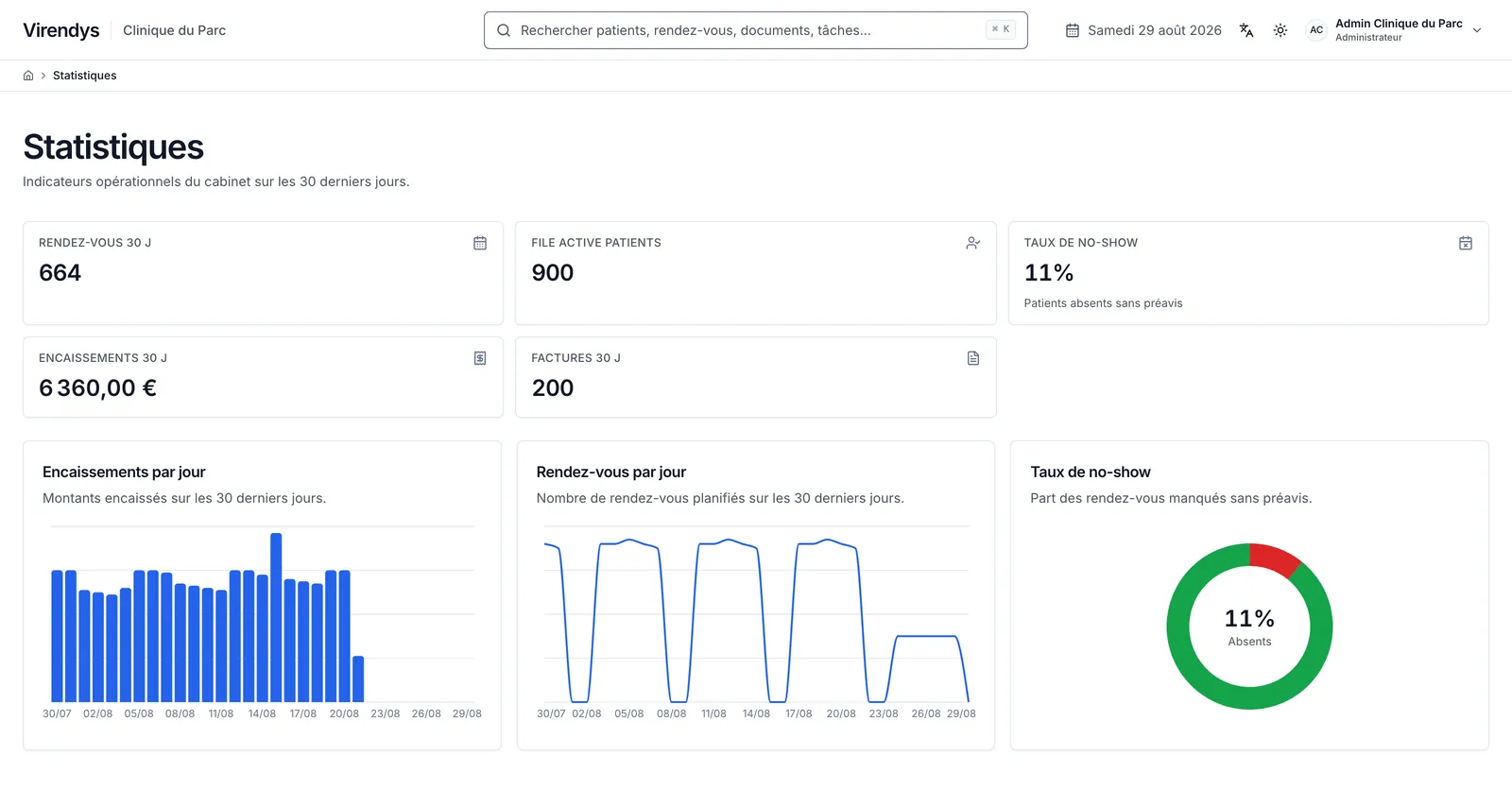
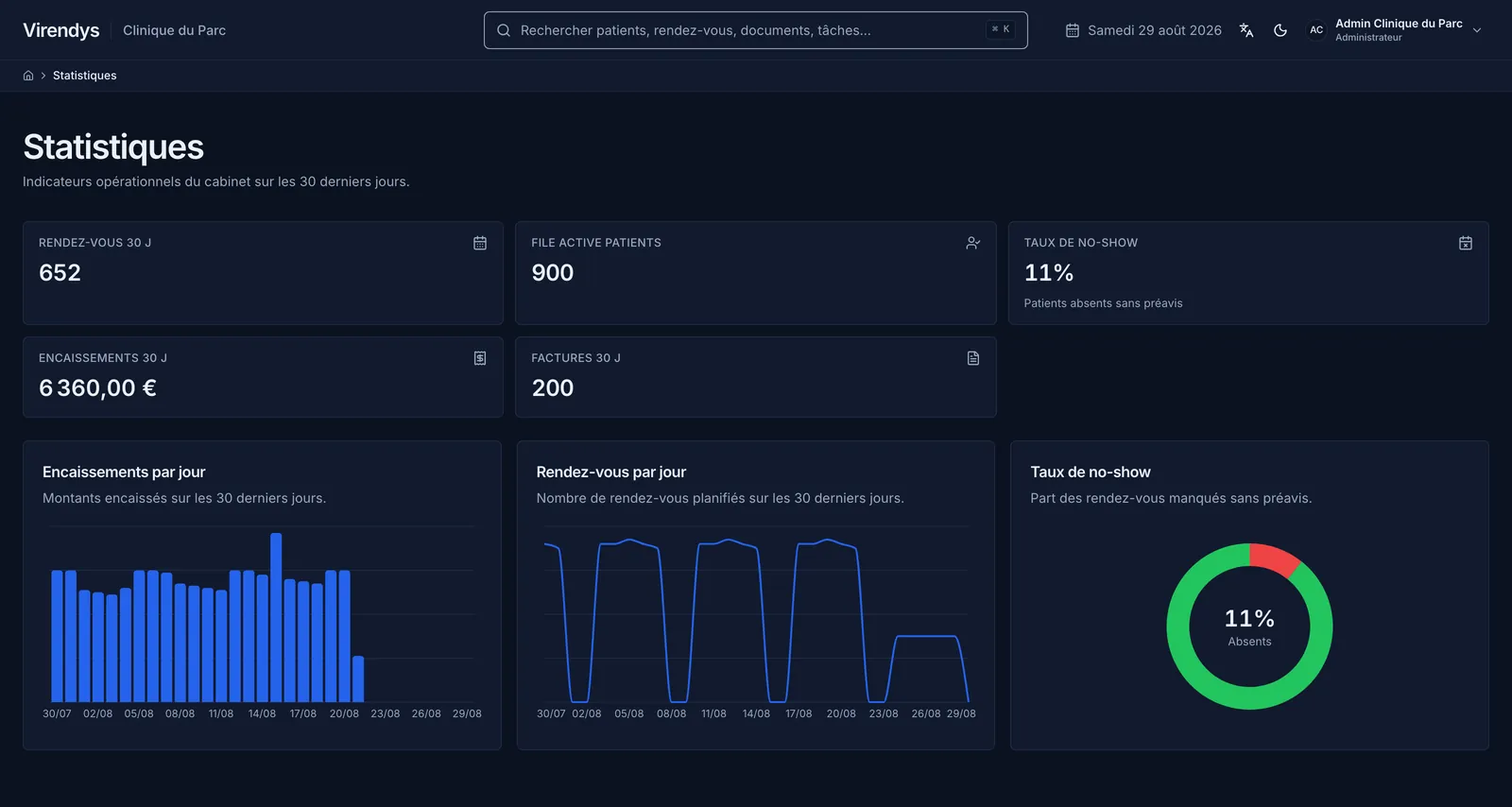
Management sees outpatient activity without asking for it
Appointments, active caseload, no-shows, revenue and invoice count over a rolling thirty days.
Demonstration environment filled with synthetic data. No real patient data appears here.
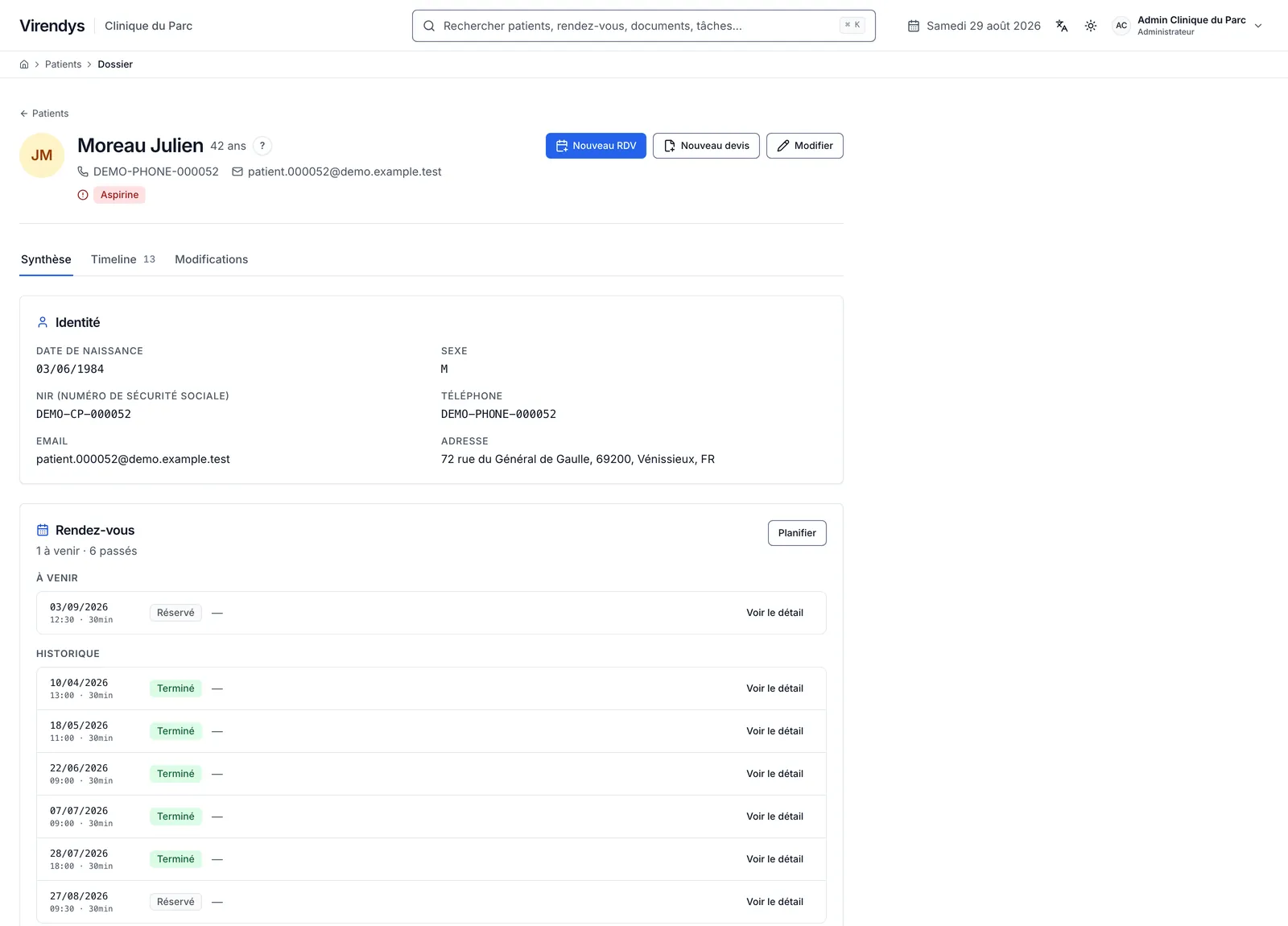
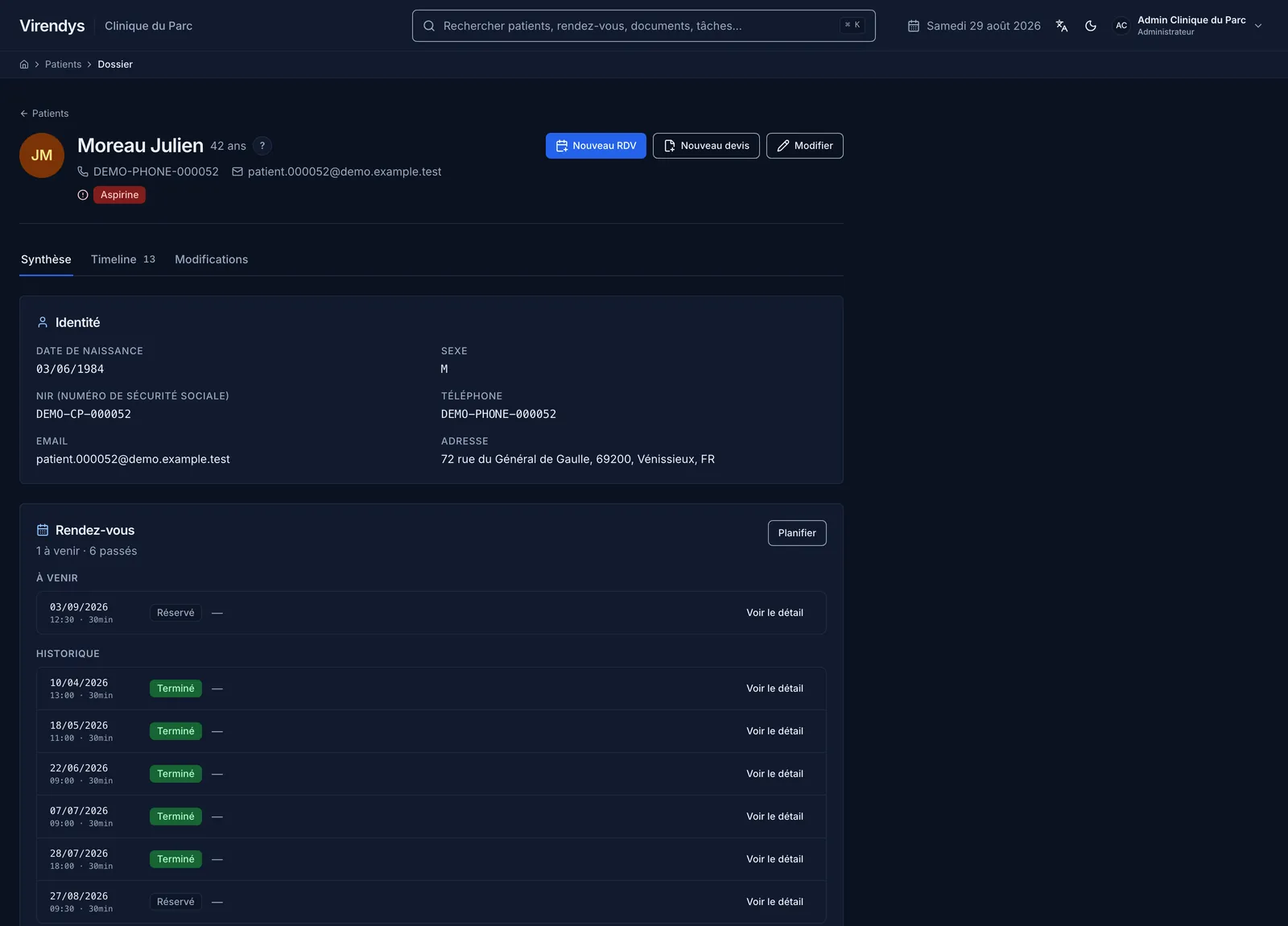
The patient record is complete at the point of care
Identity, allergies and history available immediately, and logged without any action on your part.
Demonstration environment filled with synthetic data. No real patient data appears here.
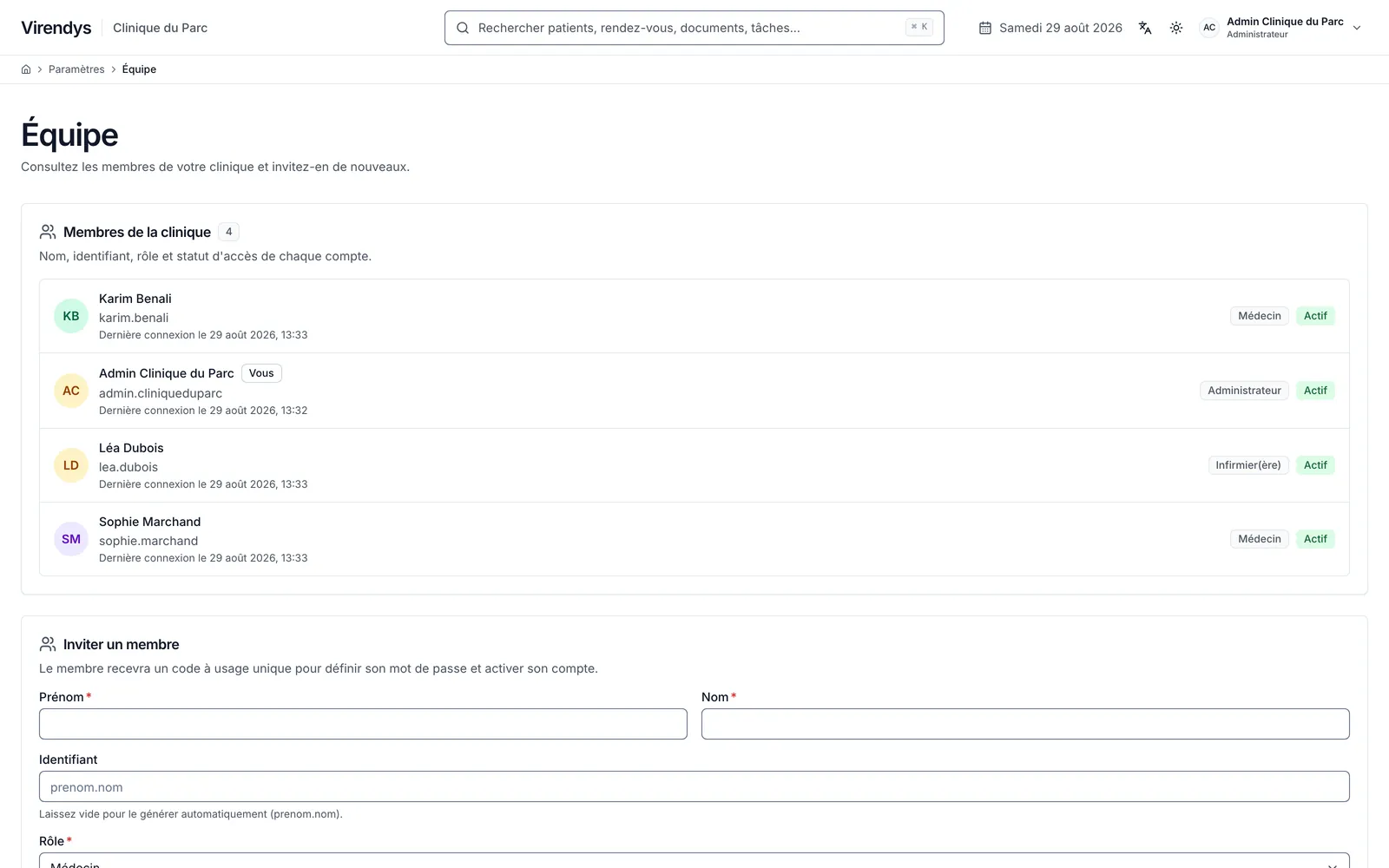
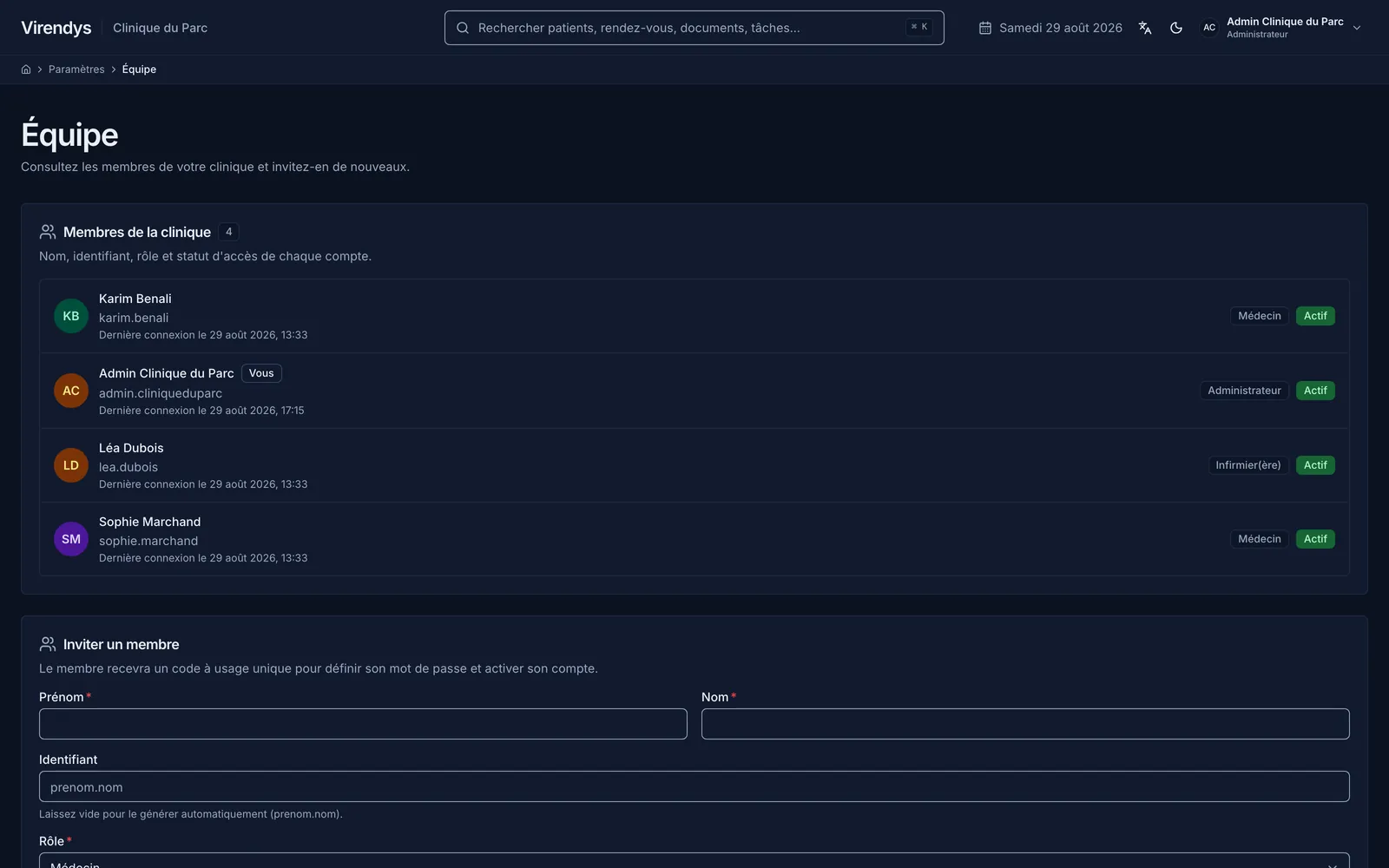
Access rights are legible and enforced
Documented roles and permissions, two-factor authentication, interface keys and webhooks for your integrations.
Demonstration environment filled with synthetic data. No real patient data appears here.
What changes
One outpatient tool, across every site
Every line below is delivered and usable today.
Deployment
It sits alongside what you run, not in its place
A group whose information system is already structured does not need a tool that overlaps the one next to it. Virendys deploys on the outpatient perimeter and leaves the rest in place:
- Your inpatient EHR remains your inpatient EHR.
- Your patient portal remains your patient portal.
- Your reference data and directory remain the source of truth.
- Deployment happens facility by facility, with no group-wide cutover.
That is also what makes the first conversation short: if no outpatient workflow in your facilities is still manual or re-keyed, we tell you at the first meeting rather than the sixth.
Scope
Three systems today, or one
A facility that wants to cover outpatient care, its certification work and its staff rotas buys three systems from three different vendors today. Three contracts, three user directories, no shared data. That is how the market is arranged; we made a different choice.
- 01 The outpatient system Patient records, scheduling, documents, billing.
- 02 The quality management tool Self-assessment against certification criteria, supporting documents, action plans.
- 03 The time and rota system Staff roles and shifts, absences, replacements.
Virendys brings them together in a single product, across the outpatient perimeter. The outpatient part is delivered; the other two are described below.
What is coming
Six modules built, being finalised
Developed and tested, they are not yet in service in any facility.
- 01 Quality-of-care certification The French health authority's certification referential inside the product, edition by edition. The 2024 version (3 chapters, 15 objectives, 132 criteria) is available; the screen shows the edition in force (the 2025 version until 31 December 2026, then the 2027 version) with its official source, and each position stays attached to the edition it was taken under. Each criterion carries its position, its supporting documents, its links and its references. The manual's scope rules are respected: a facility with no maternity unit sets aside the criteria that do not concern it, rather than skewing its completion gauge. No position is ever written by the product — a person decides, always.
- 02 Funding agreements and commitments Agreements signed with your regional health agency, their dated commitments and the supporting evidence attached to them, in the same place as the criteria they relate to.
- 03 Shift planning Roles and shifts per site, week by week, created, reassigned or cancelled from the grid. Two shifts cannot overlap on the same person: the database refuses the write. A shift with no holder is a vacancy, not a conflict.
- 04 Assisted staff placement For each vacancy, the ranked list of people who can cover it, with the reason for their ranking — and, for those who do not fit, the quantified reason they were excluded. The manager ticks what they keep: the assignment is their act, not the engine's.
- 05 Personnel records Contracts and amendments, alerts on contract end and probation end, and a space where each employee consults their own record.
- 06 Per-facility scope Current site selection and access rights attached to the facility, for a group rolling out site after site.
Assisted placement never qualifies an assignment: the only interval the engine knows is the one your facility entered in its settings. We neither pre-fill it nor recommend a value — interpreting employment law belongs to the employer who answers for it.
What you can audit
Three guarantees, verifiable rather than promised
- 01 Accessibility is measured, not declared Text contrast, the binding of every hint and error message to its field, and the reduced-motion fallback are checked by tests that block release. This concerns the software itself, not a marketing page.
- 02 One facility's data stays with that facility Separation between facilities is enforced by the database engine, not by developer discipline. A test tries to break it on every release of the product; if it succeeds, the release does not ship. We can show you that test.
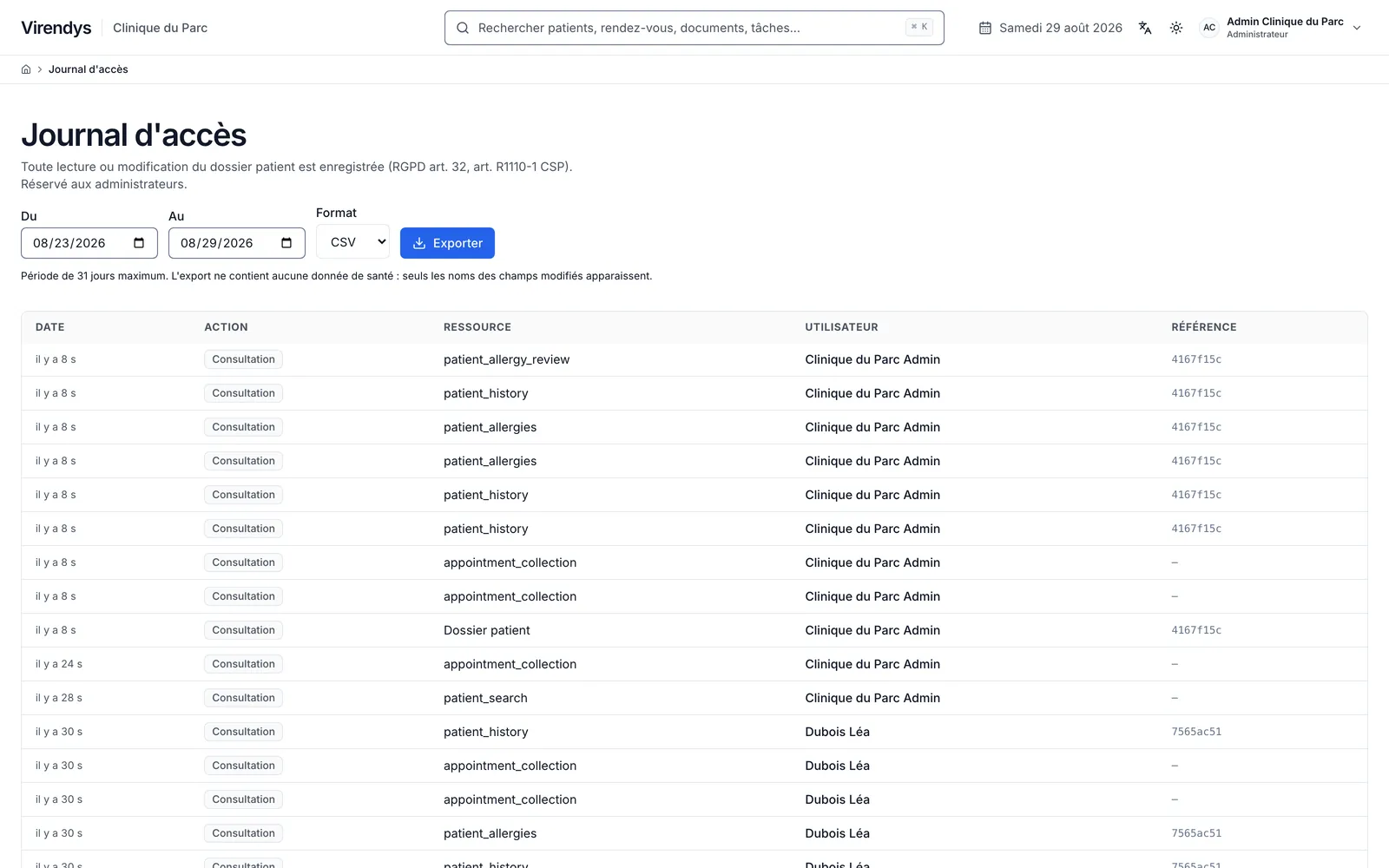
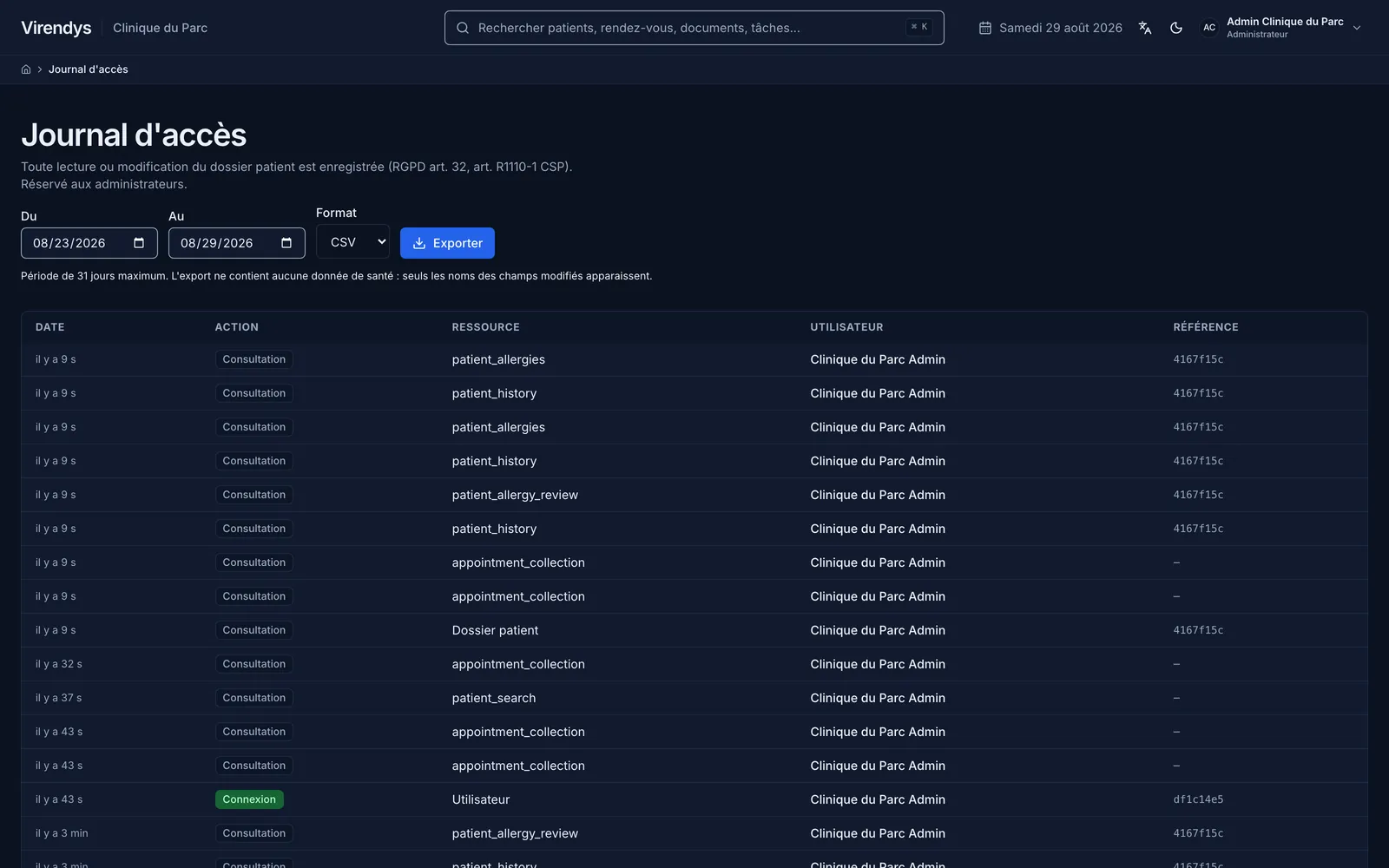
- 03 You know who opened which record Every read of a patient record is recorded — who, when, what — and the list of accesses to their own record can be handed to the patient who asks for it. This is not a module to switch on, it is the default behaviour.
- 04 Your data leaves with you Records and ledger entries export in standard formats, at no charge, with no processing delay and no exit negotiation. Reversibility is a contract clause.
Getting started
A bounded pilot, with criteria written up front
The scope follows from your workflows; it is not picked from a catalogue. That is what the first conversation is for, and nothing else.
Which outpatient workflow is still manual, fragmented or re-keyed across your facilities — despite your group platform?
It is the only question of the first meeting. The answer decides the scope, the duration and the success criteria.
Our commitments
What we put in the contract
Health software is judged as much on its clauses as on its screens. Here are ours — the ones a buyer in this sector knows to be rare.
- 01 Reversibility at no charge The day you leave, your records export in FHIR R4 and your ledger entries in FEC format. No quote to request, no processing delay, no exit fee.
- 02 No minimum volume Framework contract with no commitment on the number of sites deployed. You are not buying a promise of roll-out, and we do not bill for sites you have not opened.
- 03 No exclusivity Your patients keep booking where they are used to booking, and the tools you run stay in place. We handle the inside of the facility, not the public-facing shopfront.
- 04 The access log belongs to you The timestamped list of accesses to a record is readable by your administrators and handed to the patient who asks for it — without going through us, without a support ticket, without delay.
- 05 A bounded, paid pilot Eight weeks, a contractual end date, no tacit renewal, success criteria signed before the start. A paid pilot commits both parties; a free pilot commits no one.
- 06 Supplier documentation released for review Data protection impact assessment, sub-processor register, threat model, software inventory, incident response plans. Handed to your teams to be examined, not summarised in a brochure.
None of these lines needs to be taken on trust: they are in the contract, not only on this page. Ask us for the draft contract before the demonstration if that is what matters most to you — it is a reading order we are happy to accept.
A first conversation, forty minutes.
We look at your outpatient workflows and find the one that costs the most time today. The demonstration comes afterwards, once we know what is worth showing you.